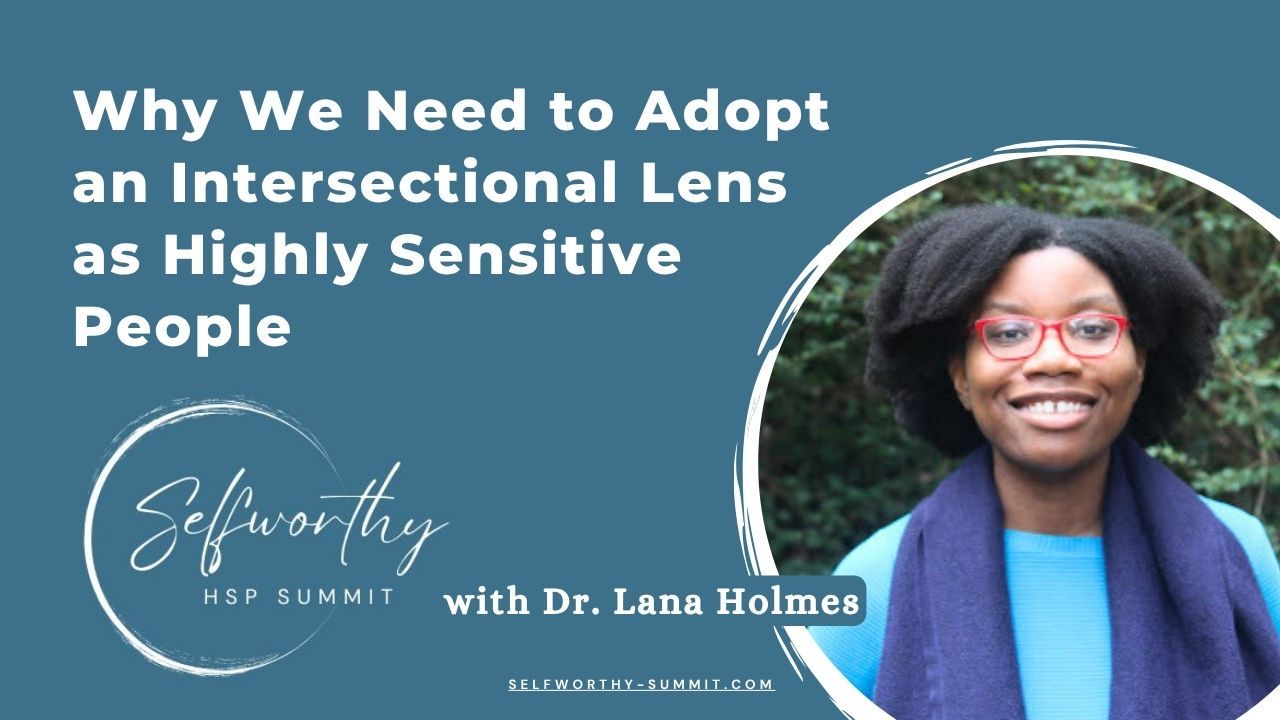
Kate: Welcome back to the Selfworthy HSP Summit.
I'm Kate Lynch, and I am overjoyed to introduce you to Dr. Lana Holmes, a clinical psychologist at the Center for Inclusive Therapy and Wellness.
She is passionate about supporting people whose lives and identities are complex and multifaceted. Her work explores the intersection of mental health, spirituality, race, gender, sexuality, and relationships. She has experience working with BIPOC and LGBTQIA2S+ communities, and with people exploring BDSM, kink and ethical non-monogamy.
Dr. Holmes brings an intersectional lens to trauma life transitions, anxiety and depression, helping people honor the full richness of who they are. Welcome Dr. Lana.
Dr. Lana: Thank you so much for inviting me to be a part of this summit.
Kate: I'd love to start with a very short grounding. To attune to each other and to our guests. This is something I do often. It helps me to digest new ideas. This web between thumb and hand. I squeeze it pretty firmly. It can be pretty grounding I find.
Just take a breath doing that, relaxing your shoulders and finding spaciousness in your spine, and then relax anytime.
So many highly sensitive people are trying to understand themselves in a world that hasn't always made space for their sensitivity.
And for Black women and fem folks in particular, that journey can be multi-layered. Many conversations about highly sensitive people treat sensitivity as if it exists in a vacuum.
From your perspective, Dr. Lana, what changes when we look at sensitivity through an intersectional lens?
Dr. Lana: Yeah, so I find sometimes when people talk about sensitivity, it's presented as if it's the main part of one's identity. However, if we look at how multiple aspects of our identity are incorporated with sensitivity, then we can see that there's a lot more complexity and nuance there in terms of how sensitivity is regarded, how it's expressed, how people respond to it.
Kate: So why is it important to consider race, ethnicity, and gender when we talk about highly sensitive people?
Dr. Lana: I find that there can be a certain cultural component to sensitivity in terms of how it's regarded. And when we think about different demographic variables like race, gender, sexual orientation, how people feel about their own sensitivity or how society or other folks in their life feel about it can vary.
So for example, just looking at gender, particularly for men and masculine identifying people, they can be castigated for being sensitive and expressing sensitivity.
On the flip side, if we look at women and femmes, there's almost this expectation. Of course, like as a matter of your natural state, you should be sensitive, but then at the same time, being criticized for it or not being taken as seriously, perhaps, because you're sensitive. People doubting your intellectual prowess, your skillset, your ability to do work, especially if it's hard work.
Those are probably very common examples that people may have. Like, this other aspect of my identity can significantly shift the way I feel about my sensitivity. 'Cause also, if you are in an identity where. Sensitivity is seen as being unnatural or as something that you should hide, then that can cultivate feelings of shame. Like, oh, there's something wrong with me.
I'm letting people down if I'm sensitive, and that's not allowed.
Kate: Yeah. A lot of times in our culture it's dismissed as a weakness.
Dr. Lana: Absolutely.
Kate: So in your experience, what unique challenges do Black women and fem highly sensitive people face?
Dr. Lana: For Black women and femmes, there often are these stereotypes that frame us as being loud, boisterous, outgoing. So if you are a Black woman or femme and you are sensitive, there can be this response of like.
Oh, that's odd or that's an anomaly.
But also as Black women, we are facing multiple forms of discrimination. So specifically anti-Black racism, misogynoir, which is misogyny, that's specifically focused on Black women and femmes but also sexism.
And I think for me and so many other Black women and femes, we have been, conditioned but I think it's almost like prepared if you're living a world that is not going to care about you or extend compassion and empathy towards you, and is also actively attacking you at the same time.
So if you are sensitive or soft or vulnerable, you are opening yourself up to further danger and you're not gonna be adequately prepared to defend yourself or others. So if you are a Black woman or femme and you are highly sensitive, it can feel dangerous. And it can feel almost impossible to be like, well, how do I navigate systems of oppression and all that come with it, but at the same time be true to myself and have room to be soft or delicate or even just relax.
It's a lot to try to hold onto all at once.
Kate: Yeah, I just imagine, having the conditioning that I had. And then on top of that having the feeling of threat or danger. The conditioning I had of people pleasing as the way to connect and receive love.
And then on top of that, have this expectation, you've gotta work twice as hard and be twice as good. And you've got to protect yourself. Just trying to integrate all of that at the same time.
Dr. Lana: It's very dysregulating. So I mean, if you look at any of the research or evidence base around the effects of multiple forms of oppression, but specifically like anti-Black racism, misogynoir, sexism, it is continuing to have a deleterious effect on the mental, emotional, physical, and spiritual health of Black people as a whole, but also Black women and femes in particular.
When we talk about word like intersectional, which was coined by Kimberly Crenshaw, she specifically was talking about how Black women and femmes are experiencing marginalization from multiple sides. Imagine having a slab of stone laid on you. One slab is one form of oppression and then another slab is added. It's like that and having to carry that around at all times and not getting the help because I think it's one thing to be attacked. It's one thing to be vilified. But then when there also isn't this willing, able, robust system of support to intervene, that adds another additional layer of stress.
Kate: Yeah. There's like this expectation that you're gonna be strong.
Dr. Lana: And I think that's another stereotype which can be hard. The strong Black woman trope. You will bear an unbelievable amount of responsibility and duty, not only for yourself but for others.
Even if it's a lot, like you can do it. Both inside the Black community and outside, it's been framed of wow, how wonderful that you have that amount of strength, instead of realizing like no human being can hold such a significant amount of stress and responsibility at all times without it breaking you down.
Another side effect of the strong Black women trope is people assuming that Black women and fems and AFABs don't need help.
I think in my life and when I observe other Black women and fems and AFAB throughout history and in my life and in my community, you have to be screaming or nearly dying for folks to go like, oh, maybe this is too much for you?
It isn't until something really dire or extreme happens of it being like, oh, we all need to come in and support you now.
Kate: When and how does it get signaled that yes, I literally am cracking and the weight of all these slabs are crushing me.
Women that I work with and connect with in the parenting world who are Black mothers of kids with disabilities, and single parents. I don't know how it all gets handled.
Dr. Lana: I think there are a couple of things. Often, there can be this sense of, I'm asking for help. It's being invalidated. Receiving the response of, you just need to push through, or you just need to figure it out.
So I don't think it's a lack of trying to seek help. If there are Black women fems and AFAB who aren't asking for help, it can be the sense of discouragement. Like, I've already asked for help multiple times, I haven't gotten it. I don't wanna put myself out there again, only to be disappointed and hurt.
Yes, there needs to be reciprocal, bilateral communication. But also, if you are able to hear a story from somebody and go, oh, that's a lot. I can tell that you probably would benefit from some support. Being able to have that same kind of reflexive thing that you would for anybody else. That's the thing that I think is missing. For example, white women where they may be in dire straits or a position of need and people can automatically go, hey, I just wanna check in on you. I know about these people or these places we could connect you to. And there isn't that same level of thoughtfulness automatically applied to Black women, fems and AFAs. It's almost like people don't even think of it unless there's something really overt to make you go, oh!
Kate: And instead sometimes it's judgment. With the parents I know it's, you've just gotta be tougher on that kid. Which is total BS. And sure people have said things like that to me as a white parent at times, but it's so much easier for me to push back. And I've seen people be dismissed or be stereotyped when all they're trying to do is get the support that their kid is legally entitled to.
Dr. Lana: Yeah. That's the difference. Asking for help, there will be dismissal. There will also just be flat out people who don't care if we're gonna be honest. Or people who will get frustrated and angry with you when you reach out for help.
So those are the things. It's like there's all these different barriers and also, frankly, indignities a Black woman or fem or AFAB has to go through. Almost like I have to prove that I am worthy of being helped, or that my concerns are valid and serious in order to just be helped. Rather than people just going, you don't have to prove anything to me. You are worthy of the support and we're going to give it to you because it is legally obligated, or because it is the humane, ethical thing that you would do for anybody.
Kate: Those words, dignity and humanity are really top of mind for me right now in this conversation. Obviously we have to do something.
Sensitivity is often framed as something people need to hide in order to survive. How can embracing our sensitivity help us fight anti-Black racism or gender oppression?
Dr. Lana: There are a couple of different ways to answer that. If you are white or you are a person of color but you're not in the Black community, using your sensitivity as a tool for empathy and compassion.
Not just feeling our experiences and pain as if they were your own, but also letting that move you to do something. Not just like sitting on the outside looking in, but being like, if I'm feeling this, I can only imagine how you feel we need to come and be with you in this.
That's one tool of using, your sensitivity to fight back against anti-Black racism. But if you are a Black woman fem or a AFAB, realizing that it isn't a liability, that it actually reaffirms your humanity. The crux of any form of oppression is it's dehumanizing and it's soul crushing especially if we look at oppression that's geared towards cruelty, discrimination, and prejudice towards entire groups of people. It's designed to make you view those people as if they're not human.
It's also more subtle. Not even recognizing when somebody is being mistreated. We all are supposed to have the same treatment and you are not getting it. This is inhumane. This is not just unfair or unjust. You are not being treated as a human being.
Kate: By participating in those forms of dehumanizing oppression, as a white person it wouldn't help my humanity. And it certainly wouldn't be honoring the sensitivity that I have to be like, they're struggling, but I don't know how to help, so I'm not even gonna ask.
Asking like, how can I help?
Dr. Lana: Yeah. Sometimes what happens is this can feel intimidating for people or people can have conflicting thoughts and feelings about it. Also, people can be afraid of messing up or making somebody feel worse.
But I think if you do care but you don't know what to do, engage in brainstorming with somebody.
It's perfectly fine to go to someone and be like, I see that you're struggling. I wanna help. I don't really know what to do. Could we talk about options that could possibly lead to a solution? What resources are available that they could access or that I could access on their behalf?
It's important not to let not knowing stop you. All of us have faced things that we don't know about, that we're not experts about, but because the issues at hand are so important, or because we love them so much, we're going to go, I'm gonna figure it out. I will put myself outta my comfort zone to see if I can find a solution.
Kate: Yeah. I would say the people who are listening to this are in general highly sensitive.
Dr. Lana: Yeah.
Kate: So even if they haven't had these thoughts or ideas before, there's gonna be that inclination to care. And to want to lift the suffering of mm-hmm. Especially people they identify with other highly sensitive people, I would think.
Dr. Lana: Absolutely.
Kate: I loved the way you framed it, if you are in this group, living as a sensitive person is a way of answering that kind of stereotype or pushing back against that dehumanization.
Dr. Lana: Thinking about the experience of other Black women fems and AFABs, there can be this sense of having to put on a shield to the outside world where I have to figure out how I can keep myself safe. Deter any possible antagonism or aggression towards me. And because of that, the expression is sensitivity requires a certain level of vulnerability and you can only really do that if you're safe.
If you're living in a world that is not safe for you, it is hard to fully express that. But also if there are stereotypes in the world or in your society that make it seem like it's weird or unnatural for you to be sensitive or to express sensitivity, or that somehow you are, in this very rare group for being sensitive.
A number of other racial and ethnic minority groups experience people looking at us as if we're all the same. So being able to say, yes, I'm sensitive, but also it's not rare. There's so much heterogeneity in the Black community and in other communities of color. It's a way of breaking down the various forms of racism, which basically says you're carbon copies of each other and there are certain stereotypes about who you are. There is no deviation from that.
So if you say, I'm sensitive, and if you are thinking that's weird, I have never met a sensitive Black woman or girl or femme before then that means you need to change your way of thinking.
Kate: And you might have, but they had to wear a shield around you.
Dr. Lana: Yeah.
Kate: So what kind of support do Black HSPs need in order to safely cultivate and express their sensitivity?
Dr. Lana: When we talk about any of these issues like social justice, activism, diversity, et cetera, I feel like a lot of it has been very intellectualized. Do not get me wrong, i'm a huge nerd. And it gets so over intellectualized that people are missing the emotion. We as HSPs, and it's still a work in progress for me, how to get people to realize, you need to feel it in your heart and soul. When I think of some of my earlier experiences of being made aware of people outside of my community.
Their stories and histories, yes, there's that empathy 'cause it's oh, even if it's not exactly the same, I understand what that experience of discrimination or prejudice is like. But at the same time, I didn't need a book for me to care if that makes sense. It's just like as soon as I heard, this is the history of what we've gone through for X Group.
It disturbed me and it made me go, how could any human being be treated like that? What is wrong, and what needs to be done? How can I help people and be prepared to help people that are also experiencing their own forms of discrimination.
That's my call to action. Feel it and let that emotion move you the same way that a motor and ignition moves a car.
In your home, workplace, school, neighborhood, et cetera, could you do something about it? If you've been in the stage of awareness, consciousness raising, digesting information and disseminating it, I think the next stage is how do you synthesize all of that and put it into action in a way that is as reflexive and natural as breathing.
For anybody who's not a Black woman or a fem or, AFAB that's listening, you don't have to be perfect at this.
You can figure out, okay, how do I make this better? I do not want people to feel so distressed or intimidated by this process that they're like, no matter what I do won't be good enough. No, it's important to engage.
It's about being a good person. Live out your values, put them into practice. If you mess up, do all the work that you need to do to take accountability for it and make things right and keep going.
Kate: Yeah.
Imagine a Black highly sensitive person watching this who spent years believing their sensitivity is a liability rather than a gift. What would you want them to remember about the value of their sensitivity?
Dr. Lana: Your sensitivity is sacred because it reminds you that you're a human being and you deserve to be treated as such. The moment that you lose your sense of feeling for yourself and the world is the moment that the poisons of oppression infect you.
Kate: Yeah. Thanks.
Dr. Lana: Thank you.