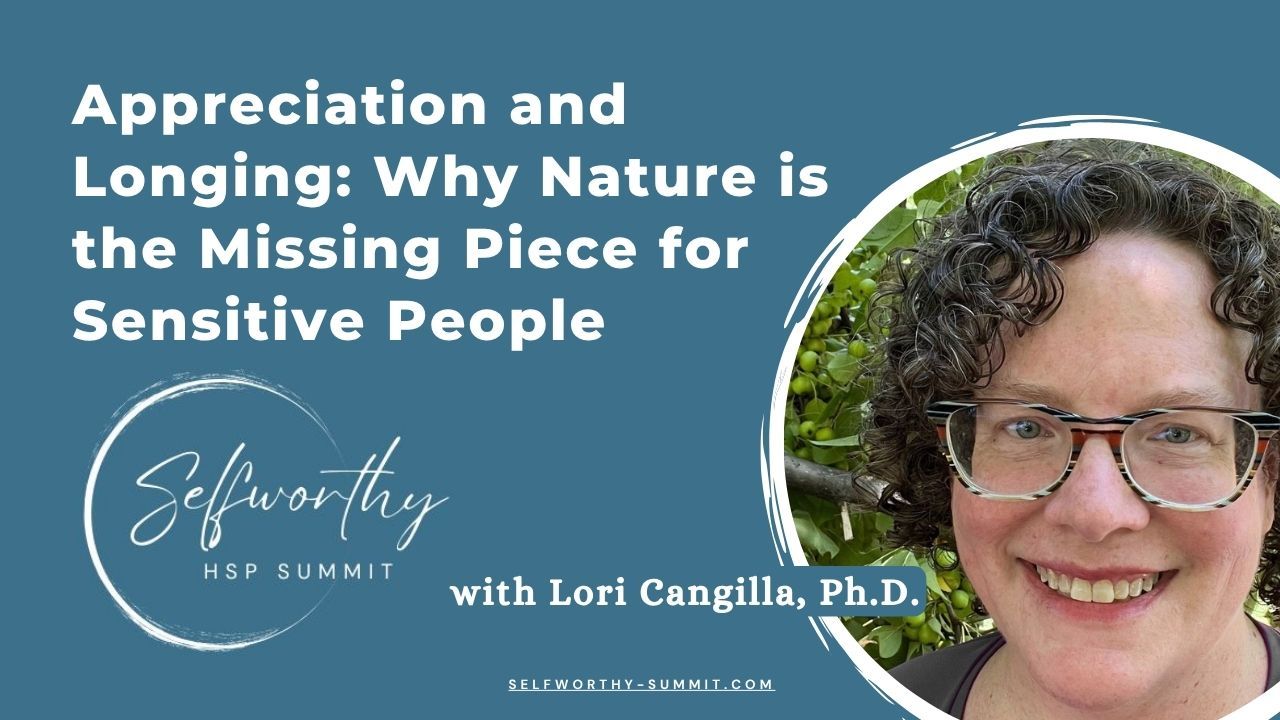
Kate: Welcome to the Selfworthy HSP Summit. I'm Kate Lynch, and this is Lori Cangilla. She is a licensed psychologist, a coach, and a certified forest therapy guide based in Pittsburgh, Pennsylvania. She has over 25 years of experience helping highly sensitive people worldwide to make a sustainable impact by building lives rooted in the uniqueness of their sensitivity.
As the founder of Singularly Sensitive, Lori has developed an approach that prioritizes four nourishing relationships: with oneself, with nature, with mentors, and with a community of kindred spirits. You'll often find Lori hiking in Western Pennsylvania with her family and tiny dog.
I just need to know what breed of dog you have.
Lori: He is a cava poo and he's about six and a half pounds. He's got like the legs of a giraffe and a tiny, tiny body. He is a fabulous hiker.
Kate: We have a cockapoo. He is mostly body with these little legs.
So Lori, I'd love for you to start us off with something sensory. Imagine we're walking alongside you on a forest trail. As a highly sensitive person, what would we notice?
Lori: Yeah, so my hunch is that before we even get to the trail, you have been noticing things that a non highly sensitive person would just miss. You are already starting to tune into the feel of the air.
You are noticing the air is a little cooler. You start to hear the wind moving through the branches, the leaves, the grasses. You've probably already scented into some wet ground or the smell of a flower blooming.
You certainly are noticing if there are any birds or animals, you're noticing the other humans and you feel their energy. Your eyes are taking in the whole scenery, noticing color, probably making some associations, and all of this is happening under the surface as your body starts to calibrate to this different rhythm.
Kate: Thank you so much for that.
So you described nature as the missing piece for sensitive people. What is it that nature offers highly sensitive people, especially at the level of the nervous system, that humans systems often don't?
Lori: For me, what nature really seems to do is take advantage of the way that highly sensitive brains are wired. Our brains are really active and lots of parts of our brain are lighting up as we're having different experiences. And we're making lots of connections between those parts of our brain.
So when we go into nature, we are getting such an abundant amount of sensory information in. And then all the emotional, the spiritual, the memories, those light up too, and it's this richness that's happening. But it's not happening in the way that so often when we're in human made systems, things are overwhelming.
They're fast paced, they're rigid, they're demanding.
When we're in nature, there's this flexibility.
So it's really about tuning into the way that we're meant to be operating in the world. Evolutionarily, as sensitive people, we feel that disconnect.
Kate: If I go someplace that has more nature, when it's time to go home, I feel a deep sadness and longing welling up from within.
Lori: Yeah, I feel that too.
It's a grief that comes.
Kate: Yeah. Which ties so perfectly into my next question. What happens to highly sensitive people when a nourishing relationship with the natural world is missing from their lives?
Lori: We feel that emptiness. When we aren't relating to nature, there's a piece of who we can be that's missing.
It gets us feeling like there's something wrong with us.
And for me it's a real quick spiral into criticism about being highly sensitive. I know that's probably a sign that I do need to go walk in the grass and get a little bit of reconnection.
As highly sensitive people, we are very, very deep in our internal experiences, and that's beautiful, but I think we can bring that out into the world best when we are in relationship with all that's around us.
Kate: So Sensitive people are often told they're too sensitive for the modern world. How does being in relationship with nature change the way a highly sensitive person understands their sensitivity?
What might they notice in their body?
Lori: Yeah, that's a great question.
One of the messages that so many of us take away when we start to spend more time in nature is that there is a place for everything.
Nature can really help us remember that there is a reason why our sensitivity is here.
There's a need for beings that can slow down and be more thoughtful. So how we experience that in our bodies, is often an awareness of, if I'm in nature and I'm tuning into the natural world around me, I am going to notice that my breathing slows down.
I am going to notice that I become more aware of the rest of my body, not just what my mind is doing. And that is part of what supports us.
Kate: You talk about nature as something that we can participate in, not just benefit from. What do highly sensitive people receive from nature, and what do we give back through our way of being.
Lori: We get that co-regulation with the pace of nature.
We develop a sense of interconnectedness and all the self-acceptance and self-compassion that can come from that.
Go deeply into our ability to experience awe and wonder and aesthetic satisfaction. I just felt so spiritually alive in this setting.
What we can give is, first thinking about what it means to be sensitive and show up in a relationship.
We are warm, we are gentle, we are caring, we are accepting. We are loving. If I approach my dog and I'm in that frame, how receptive he is to me versus if I'm irritated and he picks up on that.
Animals pick up on our mood, our intention, all of our nonverbals. Well, the rest of nature is picking up on all of that too. When we step into the forest and we allow ourselves to feel that love and appreciation for the setting we're in, it creates this really beautiful feedback loop.
If we love someone or something, we care about them, then we're more motivated to do what's in their interest. When we feel gratitude for nature, then we say, what is the impact that I could have? And we're more motivated to make those positive choices.
That is what sets up more of a culture of care and appreciation. Tending the earth as opposed to an extractive, exploitive relation of nature, just gives me all of this.
Kate: When you said culture of care and appreciation, I felt that in my body. What would that be like if this planet, if the whole world adopted a culture of care and appreciation?
Lori: Yeah. Beautiful.
Kate: I live in Brooklyn, New York. With all the noise and the crowds and the concrete, it can be a real challenge for my nervous system. How might sensitive people living in busy, urban environments begin creating moments of regulation and relationship with nature?
Lori: I have really deep empathy for that. I grew up in a very rural setting.
The more urban your neighborhood is, the harder it can be to remember that we can make those connections with nature.
Can I, when I'm outside consciously shift my attention so that instead of noticing all the human made sounds and smells and sights, I shift my attention to, is there a bird in the distance?
I think it's about tuning in with a lot of mindfulness and a lot of acceptance of what is. If you are expecting yourself to have the same experience in an urban environment as you would have in the deep woods of a national park, they're not the same at all. But if we really challenge ourselves to be aware, to appreciate what is in our immediate surroundings, we inevitably find there's a lot more ways to connect with nature.
Kate: Something that I have thought about many times is Tupac's line about the rose that grew from concrete, and how nature in the city has to be so resilient. So that's something that it teaches me.
Lori: That's a great reminder for us as sensitive people, that you can have this beautiful rose that looks so delicate, and yet it's pushed its way through the concrete.
There is such resilience and life happening everywhere.
Kate: Yeah, it's great reminder. So Lori, is there a tiny experiential practice sensitive people could try right now? Something that helps their. Nervous system attune to the natural world in just a minute or two?
Lori: Yeah. So I like to do a practice I call Stranger in a Strange Land. What this involves is taking time to really deeply notice and connect with some element of nature. If you're inside, I'm fidgeting with a rock. You might look at a house plant. You might look at your glass of water. You could look out the window at a tree, whatever. But pick an object and I want you to just observe it and notice that your mind's chattering.
That's okay. Just really tune into whatever this piece of nature is that you're focusing on, and imagine that you are a stranger in a strange land and you have never encountered this thing before.
Really observe it. Bringing in as many of your senses as you can.
Being curious, why does it look the way it does? What is that feature for? What does it do?
Is it one organism or a community of organisms? You don't know anything about this piece of nature, and you are a curious explorer, and you're going to go back to your community and tell them all about this discovery. Take it in as much as you can. If it's something that you can hold and touch, you could turn it over in your fingers.
If it's something that's in the distance, I want you to just imagine, how would you describe how the surface might feel? It looks like it would be scratchy, or I just want to flip it over and see what's on the other side. I wonder what's going on under the ground. What happens when it's dark or when it rains?
As you take in all of this information in this really nonjudgmental, curious way, just observing. Does it do anything to stir you emotionally? What do you feel in your body as you're observing? Allowing all those parts of you to come online without any kind of pressure for this to be a certain way.
You may be a stranger in a strange land, but you've now made a connection with this organism. You're no longer such a stranger here. Notice what that does in your body. How does that feel in your emotions? What's going on in your mind?
Know that you can do this anytime, anywhere. Bring yourself as a stranger in a strange land with an open heart, curious mind, perceptive senses, and allow yourself to experience something in a deeper, fresher, different way.
Kate: I wanna share just a tiny bit about my experience.
Lori: Love to hear.
Kate: I chose a tree that I can see out my window that's an evergreen. I had this experience of its branches, as open and embracing. That was the feeling I got.
Lori: How beautiful that is. To just feel your body shift in relationship to something in your environment like that.
Kate: Biodiversity in trees is welcomed, embraced, and celebrated. But in humans it's often not . The more people experience and appreciate trees, I think the better.
Lori: I agree wholeheartedly.
Kate: Lori, if nature. Could speak directly to highly sensitive people, what might she want them to remember about themselves and their worthiness?
Lori: Oh, that's a beautiful question. I think nature would say that there are no mistakes. Everything has its purpose just the way it is, and that diversity is so vital.
Allowing ourselves to be fully ourselves and not if we're a pine tree, expect ourselves to be a maple or a frog or anything else. There is room for all of us exactly the way we are and we are loved and appreciated for who we are.
Kate: Mm, absolutely. I'm gonna really cherish that.
Lori, do you have something that you'd like to offer as a gift to our participants?
Lori: Yeah, i'm calling it the forest exhale, and it's a 10 minute guided meditation that brings you into a forest setting and allows you to just go there in your imagination.
Kate: Thank you. I'm going to download that because I find your voice very soothing.
Lori: Thank you.
Kate: Thanks again so much, Lori, for being here.
Lori: It was my pleasure, Kate. Lovely to talk with you and thank you for bringing all of these really fabulous speakers together and highlighting just how much sensitive people have to give to the world and how well we can take care of ourselves in the process.
Kate: You're welcome. It's for me, too.