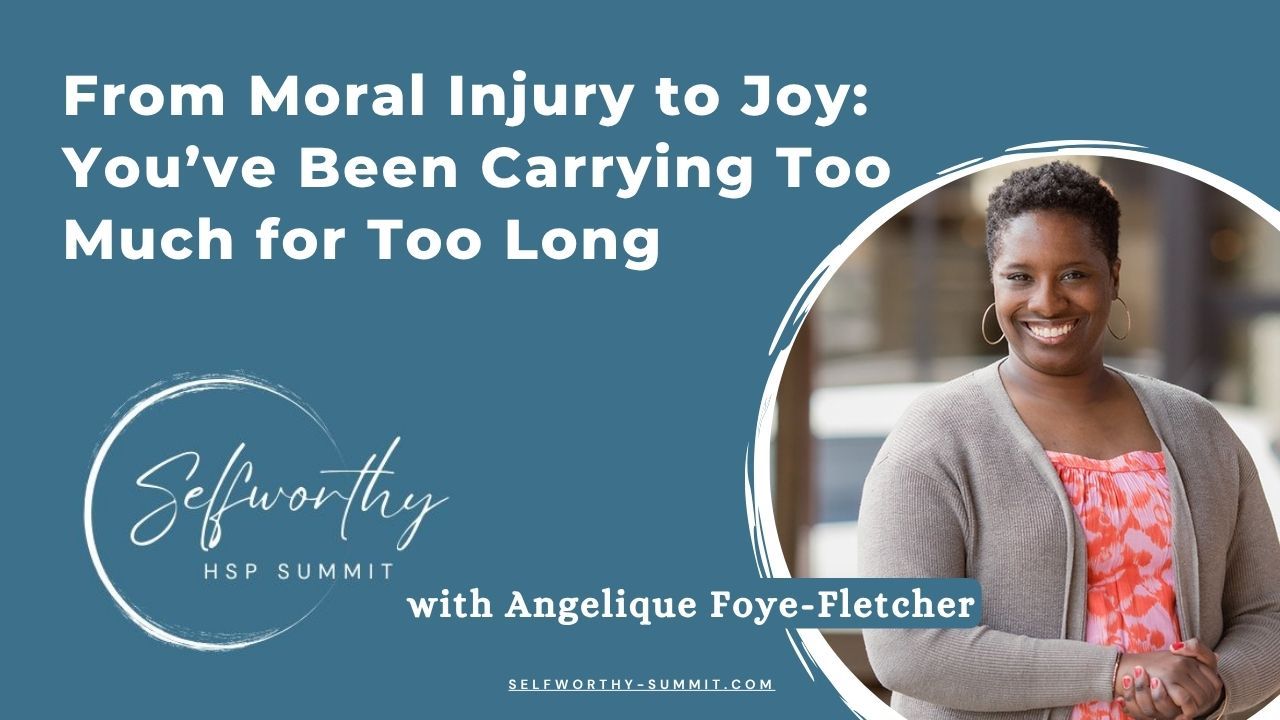
Kate: Welcome back to the Selfworthy HSP Summit. I am Kate Lynch, and today we're speaking with Angelique Foye Fletcher. She is a licensed marriage and family therapist and registered play therapist based in Kansas City. She specializes in supporting deep-feeling children, teens, families, and highly sensitive adults.
Her work focuses on emotional regulation, trauma, neurodiversity, and helping people feel seen, safe, and supported.
Angelique, I was always a serious, deeply feeling kid myself, and when my parents divorced, I was six. Something in me felt that it was my job to hold everything together. And I think that a lot of highly sensitive people know this feeling.
Becoming the strong one before they were ever meant to.
So when a sensitive child carries too much for too long, what happens inside?
Angelique: Well, Kate, yeah. Thank you so much for sharing a little bit about your experience as a deep-feeling kid, now highly sensitive adult.
What you just said, carrying too much before they even are able to really relate and understand what's going on.
What I find is a lot of kids will start to kinda lean more into being capable, helpful, right? Because you're put in the position to try to hold everyone together. So divorce, a lot of times there's grief, transition, and parents who just aren't friends anymore.
And so the kiddos, especially deep-feeling kids, feel and absorb everything, and make it seem as though it's my responsibility to stop it, right? And that's not fair, that's not kind, but that often happens when I see kiddos who are experiencing divorce, transitions, military deployment, anything like that.
And as a former deep-feeling kid myself, I grew up in a family system, where, folks really just focused on their own feelings, their own grief, abandonment that wasn't really said. But I was made to feel like I had to absorb it. And then minimize my emotions or reactions to not cause another reaction.
Kate: Yeah, that sounds really familiar.
Angelique: A lot of folks listening to this will say, "Yep, me."
Kate: So what happens to those younger parts of us when we learn that being needed feels safer than having needs of our own?
Angelique: A lot of times, the younger parts starts to get minimized, and we grow up too fast. Maybe sometimes you can't relate to peers who maybe had the whimsical, idyllic childhood.
And typically it's like that part of us shrinks. We don't wanna make space, and so we over-function.
My worth only comes from being useful.
Or we become the dependable, the reliable one. It's a badge of honor to be known as the strong one.
Am I useful to my parents, to my siblings? Versus, am I enough, right?
And so I think that the younger parts later show up in forms like, burnout, people-pleasing. One of my best friends called me Queen Crash Out. Later on I found out I was just burning out and recovering, and burning out and recovering constantly, and I was at a pace that wasn't sustainable.
So I would say the younger selves go into this form of like I gotta over-function and show up more and more without actually giving me the space to really heal, and consider my needs first.
Kate: Yeah. My mom recently wrote me a email. She said, "You were the responsible one, so I could rely on you."
Angelique: What you said about the responsible one, i'm hearing a lot in the narrative with kiddos, even neurodivergent kids.
Kate: Yeah.
So for the highly sensitive person who's always been the strong one, why can joy, rest, or receiving care feel unsafe?
Angelique: Wow. That hit me in a different way, because being able to have unadulterated joy, is being able to say, "I can be responsible. I can joy responsibly."
What would that cost, right?
It comes at a cost in you possibly saying to your mom, if you were to later on say,
" Mom, that was a lot of weight that I had to carry, and I wasn't able to tap into that joy of being a kid."
Just being a kid, trying to figure out, pushing against boundaries and stuff like that. Maybe not having the time to just be in your own world, being imaginative. I see that a lot, and that's why I became a registered play therapist.
What play therapy is, is the space just to be, to delight in the child, to be present. I even bring it with my adults when I do creative coaching. We're just like, "What makes you happy? "Does coloring in that adult coloring book really brings you that peace and joy?"
Highly sensitive people oftentimes override joy because they're exhausted, they're burnt out, and they feel like, do I even deserve rest?
'Cause when I was in a family system and was made to believe, not that it's true, but I was made to believe that the only way I can be present and feel safe is as long as I'm responsible and as long as I'm the one holding the glue. And if I don't, and let's say I decide to set boundaries, 'cause with joy is boundaries.
As an example, I don't wanna have that conversation with you right now because I'm gonna go on a bike ride. I'm not feeling comfortable having that conversation in front of my child, I wanna keep their innocence. Not made to feel like they have to absorb the energy.
And if there's one tip I like to give, letting the other person know, "You are not responsible for my feelings."
I'm responsible for my feelings. Even if you have a deep feeling kid, reminding them, "It's okay if you feel this, just know that I'm responsible, and you're responsible for yours."
Kate: It's so hard to differentiate sometimes between our feelings and other people's feelings. Especially when we love each other so much. Yeah. And of course, kids are dependent on us, right? So there's that. Yes.
Angelique: Yes. Survival, right? I grew up where there was love, there was some guidance. But there was some confusion, some chaos in terms of, women in my life constantly being in fear mode, as well as survival mode. Being a one income household, having to manage both roles. That was, hard, as well as the abandonment and rejection wounds that was caused by the absence of the other parent.
You know what I'm saying?
Kate: Yep.
Angelique: My grandmother, I used to spend summers with her in Louisiana, and I lived with my mom in the Midwest. So whenever I would come home, on our 12-hour trip, that was when I felt joy. We would talk freely. Talk about feelings, space, the world, and everything like that.
But then I started feeling that dread, 'cause I'll never forget what my grandmother told me. She's like,
"Okay, you're the oldest, you have to help your mom out."
She may not have known what that meant to me, but it put a huge responsibility and burden. To say, I know you're a kid, but you also have to be responsible in managing another adult's feelings." I remember feeling like sometimes it was easier to be the therapist.
That's why I'm a therapist now.
Yeah. Maybe you experienced this, Kate, like, people oversharing their feelings. Adults telling you you're wise for your age.
Kate: Yep.
Angelique: So imagine those two things, and you're a parent who's overwhelmed, burnt out, fear-driven, in survival mode. Of course it's easy to kinda wanna dump. Onto that child. Mm-hmm. And forget that the child's place is, they haven't learned quite yet to not take in and absorb.
Kate: They're just learning to regulate their own emotions. Yeah, I remember someone saying, kids are born with all the feelings but none of the regulation.
Angelique: The full spectrum of emotion.
That's the true joy, is being able to feel the full spectrum of it and knowing that there's at least one regulated adult who can co-regulate with you in feeling those emotions.
Kate: Yeah. That would be nice.
Angelique: So we become that for our own kids.
Kate: We become that, and for ourselves.
Angelique: And for the inner child in you that still lives on.
Mm-hmm.
Kate: Yeah. So speaking of self-abandonment, what does it actually look like in everyday life, especially for someone who's so used to caring for everyone else?
Angelique: Mm-hmm. A lot of times self-abandonment is saying yes when your body means no.
Ignoring your body's signals, right? Constantly caring for others while putting your needs down.
We talk about the trauma responses, fight, flight, freeze. But the last one, which I learned recently, was fawn. Yeah. Which is you minimize your emotions and feelings so you can feel safe, right?
So that's self-abandonment when you consistently do that.
Saying yes to things, becoming so adaptable that you lose touch with your own joy.
Kate: Yeah. Is that similar to appeasement?
Angelique: Yeah, so appeasement is like, how can I make myself small essentially, putting their needs first before my own.
Now, there's nothing wrong with being empathetic. That's important. I just wanna be clear about that.
But when it comes at a cost of, this person has continuously caused me harm, and has not made accountability, reconciliation, or recognition of that, then I owe it to myself to say,
"I hear you. I'm here. You don't feel safe."
So it's my job to let that person know, that I don't wanna talk. That's sometimes a angry boss. Or your partner, right? 'Cause you grew up, like, if this person's having a bad mood, we all kinda have to fall in line.
So when you become an adult, that means you start to say yes to more things you shouldn't have.
Kate: I'm realizing as an adult how much joy I postponed while focusing on survival. For someone else who feels that too, what's one really small way to begin reconnecting with themselves and allowing more joy?
Angelique: If I'm really honest, you have to start small and gentle.
Being kind to your mind.
That's part of my private practice. I'm here to help those to feel loved, seen, and supported.
Your brain sends you signals, right? Having anxiety attacks, but it's actually, your mind is fearful of uncertainty. A lot of times if you're in that cycle, we forget the basic steps, which is you have to start gentle and kind.
One small way to reconnect to joy,
treat yourself like an indoor plant.
Water yourself. Literally nourish, hydrate.
Get yourself in some soil. Walking out barefoot into that soil.
Getting that sunshine.
A hand on your chest, just breathing in. Pouring love into yourself, I deserve joy and love. Setting the tone that this is my gentle space to reclaim.
Having kids is a joy because now I remember coloring in my bathtub. Why does it have to stop with kids? You can have your own bath crayons and write a special message to yourself.
And talking to a person who you've deemed to be safe, reach out and talk to a therapist, or a coach.
Say, "I deserve to be gentle with myself. I will honor myself," just that.
After this talk you'll be like, "Geez, okay, Well, where do I start?"
One small act of joy is reading books that share about what is it like to grow up with a emotionally immature parent.
If you're a book learner, julie Cameron has a really great book called The Artist's Way. That's like a first step into, how do I go towards reconnecting joy.
What made me feel alive before survival took over?
Who was I before I had to put on this mask?
If y'all are ready for that journey and you're just like, "What book should I read?" Go ahead and download my Joy Revenge book list, that incorporates all the four pillars of healing that I like, which is books, connection, play, and nature.
If you're looking for more, just kinda wanna hear more of this great goodness, I am launching a podcast called Joy Revenge this summer, and I would love and invite you to listen.
One message I like to leave, this was from Dr. Harry Ponte, who's a marriage and family therapist. He said,
"We all have a birthright to be loved... and we are robbed of that experience to be loved and to love others. It is our job as adults to reclaim that. Reclaim joy."
Kate: I love it.
Angelique: Okay. Kate, it's been a pleasure.
Kate: Thank you so much.