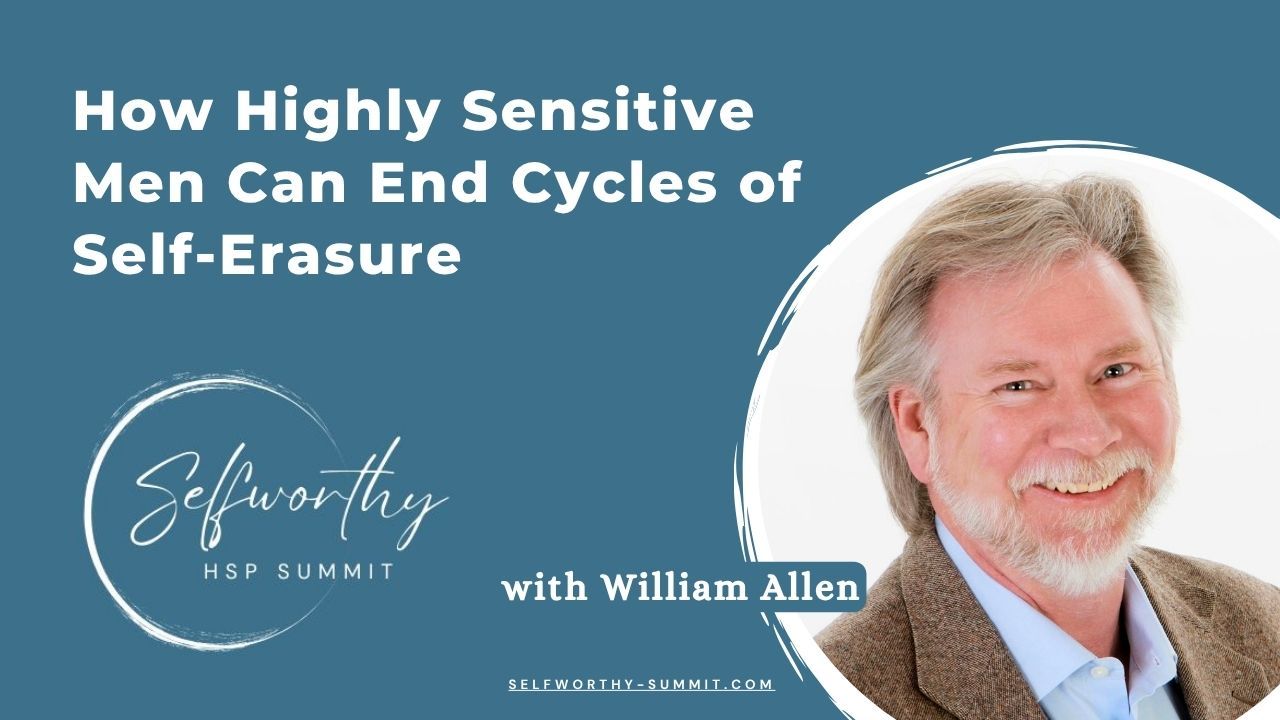
Kate: He helps sensitive men build lives that honor who they truly are, rather than who they were taught to be. He's the author of Confessions of a Sensitive Man and his new book on being a Sensitive Man. He's the founder of Brain Pilots, a hypno coaching and neurofeedback practice in Bend, Oregon, and co-host of the Still Waters podcast for highly sensitive and creative men.
So it is an honor to welcome William Allen here to talk with us about how highly sensitive men can end cycles of self erasure.
This is the Selfworthy HSP Summit.
From an early age, boys receive strong messages about how men are supposed to behave. In this conversation, we'll learn how sensitive men can stop erasing themselves, set a more humane example of masculinity, and begin living in a way that reflects their true nature.
Welcome Bill. It's so great to have you here.
William Allen: Thanks, Kate. It's great to be here.
Kate: It often takes me a moment to regulate with my nervous system, and
in this online platform to attune to each other.
William Allen: Mm-hmm.
Kate: So, maybe we could just take a couple of breaths together.
William Allen: Okay. Sounds good.
Kate: We'll inhale. You can make a sound as you sigh if you'd like. Ah,
two more like that.
Thanks for doing that with me.
William Allen: It's a good way to get yourself calm.
Kate: Yeah.
So what does self abandonment look like in the daily life of a highly sensitive man? And if you have an example that you could share that illustrates that, it'd be great.
William Allen: In real life, it looks like they don't know how to set boundaries. They'll let people walk over them. They don't stand up for themselves. They go into this cycle of self-denial.
I can tell you from my own life, I didn't find out about high sensitivity until probably in my fifties.
I read Dr. Aaron's book. And as I was reading it, it was like, yep, that's me, that's me, that's me, that's me. And after I finished the book. There was that term sensitive that was staring me right back in my face. And all the training that I had from childhood was telling me, men are not supposed to be sensitive.
I realized everything that was in the book and everything about sensitive people applied to me, but as a man, I couldn't accept it. I couldn't embrace it. I was constantly in self-denial about it.
You suppress emotions, you suppress feelings, you suppress some things that you experience as a highly sensitive person, like overstimulation. You don't wanna show that. That looks like a weakness to other men. You go through that cycle over and over. So what it amounts to is that it turns into something, what I call masculine conformity.
You're appealing to masculine definitions you were taught growing up.
And for me, having grown up in the south, of all places, which is one of the most traditional gender roled societies that we have in this country. There are certain rules for men, there's certain rules for women. And you're taught very early on, through shame sometimes, or humiliation, that if you step outside of those rules, you're gonna get pushback in a serious way. You're fighting against that programming. What I've been told all of my life, you're too sensitive, you're too emotional. It got ingrained in me. So even at that age, I started to recognize that I was pushing back on who I really was.
And in a lot of highly sensitive men's lives who are still trying to grapple with the idea that this temperament trait, this nervous system they have is okay. It's all right. And at the end of the day, you're not gonna stop being a man because you have that sensitivity.
Kate: Right.
Why do you think so many highly sensitive men grow up believing their sensitivity is a weakness rather than a strength?
William Allen: A lot of it has to do with the indoctrination that we get culturally. We also get it in media, novels, movies, television performances. We're shown what a traditional man is supposed to look like.
For a lot of us, these things that come very naturally to us, being able to express ourselves emotionally, being affected by things like watching a really tender soft hearted movie in which real emotions come through on the screen and you have a tear in your eye, or you actually start to weep because of something that you've seen that's really beautiful.
A piece of art, music, and being out in nature sometimes will cause that to happen as well. We've always compartmentalized emotion and sensitivity. Things that are tender and a more soft, endearing type emotions. And I think that's why a lot of highly sensitive men, when those things bubble up, because they will, look at them and comparing to that masculine role model that they've been taught over the years.
You're not supposed to be nurturing, you're not supposed to be empathetic. You never want to be intuitive because that's using something other than logic and reason, right?
Kate: Mm-hmm.
William Allen: So. It really boxes men in. And that narrative I think, is starting to change.
Kate: Yeah. So many men feel pressure to fit into this really narrow version of masculinity. So what parts of themselves are they giving up in exchange for that feeling of fitting in?
William Allen: In highly sensitive men, you live a hybrid life on the outside, the exterior. You're presenting as a traditional male, you suppress your emotions. You don't have as much emotional expression.
Highly sensitive people need to recognize, especially men, that emotions are human. They're absolutely wired into us and they have a purpose and they have reasons for being there and they're important.
A lot of men believe that you can express anger, you can express joy. But you can't express tender emotions, and you certainly can't express things that show weakness, which is a terrible thing because part of the catharsis of having these emotions is getting this stuff out of you and letting it go.
Instead of having a full palette of human emotion, you have one or two that you can express.
It's an insanity that I think has been perpetrated too long for men and it really does affect them on multiple levels.
You're completely leaving out an entire part of your nature as a human being. To be able to intuit things. And then nurturing for a lot of men is difficult. Although, I see that changing. I see that my son, who is a father now. He's just about 40, and I'm starting to see his way of parenting is a little bit more open, a little bit more expressive than mine was. And certainly my father's style was almost non-emotional. You can see the generational changes that are taking place, but not being able to nurture, you lose out on some of that.
We forget about caring and kindness and compassion. I'm not saying all men don't show those. I think it's been something that's been discouraged. I've even heard it lately in the news about their talking about empathy as a weakness, and I'm thinking what?
We need more empathy.
Some of those characteristics are things that we associate the feminine and not the masculine. This is where we need to go beyond that kind of thinking and start thinking about it as being human.
This is a human thing. These are human elements.
We need to start expressing our full humanity as men and be able to do that in such a way that we're comfortable doing it. Because I think what that does is it tones down rhetoric that certain men have.
Humans are social animals and we're communal and we need to be able to express all of our emotions to be able to function.
Yeah.
Kate: Makes so much sense.
William Allen: Yeah.
Kate: And I can project where that would lead. If, instead of taking generations and having backlash, we just woke up to the fact that feelings are part of being human and allowed that for everyone.
William Allen: It seems so simple, right? You're equipped with them already.
You don't have to go out and learn how to be emotional.
We're all human and we have more in common than we realize.
For men especially, expressing the feminine in them, and I'm using these terms energetically, not biologically or sexually or anything else, that gives a whole new range that men can experience.
Kate: Yeah.
William Allen: It really will make a difference. You look at the world as it is right now, there's a lot of masculine energy out there and what nature is telling us is that we're out of balance.
We're completely out of balance.
Kate: What changes for a highly sensitive man when he stops abandoning himself and begins to honor his own feelings and needs.
William Allen: I think coming out of a place where you've repressed who you are because of pressures that have been pushed in on you, highly sensitive men need to allow themselves to be their authentic selves.
For us, purpose, meaning, balance, and harmony means something. It means a lot to our nervous system to be able to do that.
When you're incongruous, when you're not allowing yourself to be authentic, you're not allowing yourself to be the sensitive human being that you are, there's no peace there. There's no balance. There's no harmony within you because you're constantly working against your nature, and the way that you're wired to be.
You can now express yourself authentically and be who you are.
As someone who did that. I can tell you that I live in a lot more peace and harmony within myself than I've ever done in my entire life because I acknowledge, yes, I'm a sensitive man. And I'm okay with that.
Kate: Mm-hmm.
William Allen: And I think when you do that. You can reach out and start pursuing a life that fits your nature as opposed to trying to live a life that fits some kind of financial portfolio that might fit what mom and dad wanted you to do.
I think that allows you to reach potentials that you've always wanted to do. What can I do that expresses that? So that allows you to, even be more happy than you are.
And then finally by doing that, it allows you to appreciate what this gift we have is in this high sensitivity. I'm not saying there are no challenges to being highly sensitive, but you learn how to manage those and when you do that, you start to realize this is a gift.
Why do we have this ability to process things in such a different way and sense things that other people, it's to get that sensitive awareness.
We see what's wrong in the world.
We see what's wrong in the environment. We see where things need to change. We are that harbinger of that truth, of this sensitive awareness and discovery.
From the beginning of time. We've had special purposes. Our purpose is to be those priestly advisors, to be those counselors, to be those ones who share this information.
This is our moment, this is our time, and this is when we really need to stand up.
Kate: Mm.
Yeah.
Many highly sensitive women and non-binary people are working to end cycles of self abandonment in their own lives. How might highly sensitive people across the gender spectrum support each other in breaking these patterns of self erasure?
William Allen: Well, I did write recently about how I thought HSP men could model themselves after the LGBTQ plus community.
When I was growing up, the term queer was terrible pejorative. It was not used in any way, shape or form in a positive way. But what we've noticed over the years is the LGBTQ plus community has just taken that word and owned it, right? You cannot take this away from us. And what that means is, gaining their power back.
I think highly sensitive people should grab the word sensitive and make it ours. By doing that, we empower ourselves. So that's our responsibility to get out there and do that. Collectively, we can work and learn from other communities that have gone through these transitions to acceptance in the greater culture. Follow them.
The human population is incredibly diverse.
I just think that's so important. Absolutely embrace it.
Kate: So what if more highly sensitive men lived authentically instead of hiding their true nature? How might that impact our world?
William Allen: When highly sensitive people are empowered, you're turbocharging some engine within us that is already very powerful in and of itself.
It is because of the way we're wired, that makes us more creative. And that's something that you can take to problem solving. Solving some of these very, very complex, complicated human problems that we have created for ourselves.
You hear things like, highly sensitive people can solve the world's problems, and we can be part of that. But I don't see us as doing something like that by ourselves. I don't see us doing it alone. That really isn't the nature of who we are. We are there to be advisors and counselors. We can be very good leaders. But often our role is more in an advisory capacity. We see these things that other people aren't seeing. We become reliable, good sources of information because we're observing all the time. And because of that, that gives us an insight into things very often our leaders don't have.
We don't have to be the majority in the world. We can be a small part of it to create a big ripple effect.
Do the things that we naturally do, and quit doing things that are not compatible with who we are. I think that change can happen naturally through just being who we are.
Kate: That makes me feel really hopeful as a highly sensitive person. And inspired.
William Allen: Yes, it is very inspiring. We need inspiration right now. And we need hope. If highly sensitive people can get past the challenges that present themselves, once they start learning about what you can do to ameliorate some of those challenges, then you've got a force to reckon with.
Kate: Bill do you have a gift for our community here?
William Allen: I do, it's at the sensitive man.com, and you look under free HSP resources. There is a thing I call a Calm Reset. it's a small audio file that will help you calm your nervous system.
Kate: Okay. And we're gonna link to it right below.
Well, Thank you so much, Bill.
William Allen: Thank you.
Kate: Great conversation.